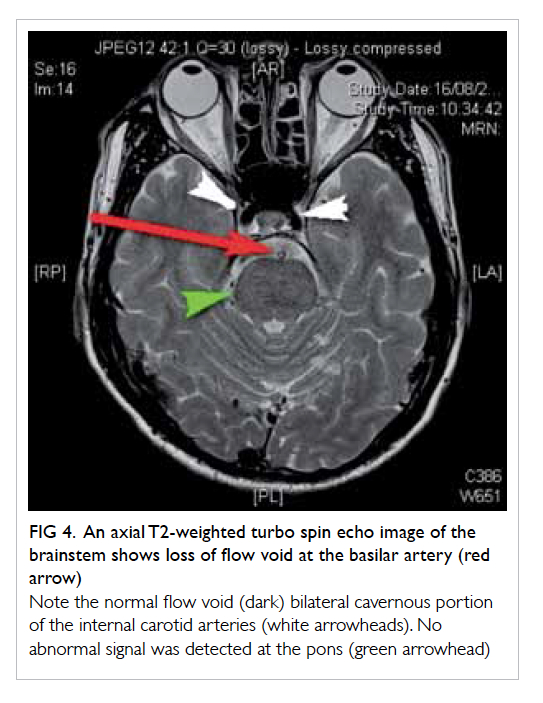
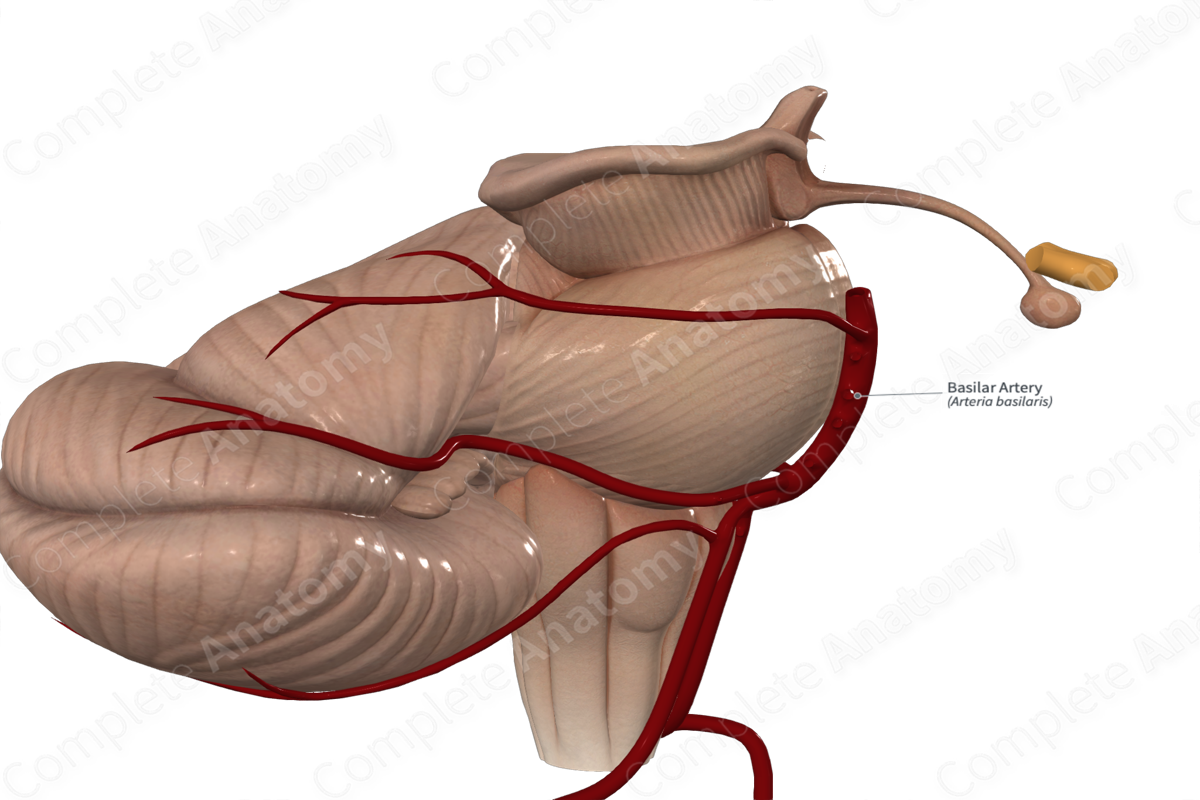
The basilar artery (U.K.: ; U.S.: ) is one of the arteries that supplies the brain with oxygen-rich blood.
The two vertebral arteries and the basilar artery are known as the vertebral basilar system, which supplies blood to the posterior part of the circle of Willis and joins with blood supplied to the anterior part of the circle of Willis from the internal carotid arteries.
Structure
The diameter of the basilar artery range from 1.5 to 6.6 mm.
Origin
The basilar artery arises from the union of the two vertebral arteries at the junction between the medulla oblongata and the pons between the abducens nerves (CN VI).
Course
It ascends along the basilar sulcus of the ventral pons. It divides at the junction of the midbrain and pons into the posterior cerebral arteries.
Branches
Its branches from caudal to rostral include:
- anterior inferior cerebellar artery
- labyrinthine artery (<15% of people, usually branches from the anterior inferior cerebellar artery)
- pontine arteries
- superior cerebellar artery
Clinical relevance
A basilar artery stroke classically leads to locked-in syndrome.
Additional images
References
External links
- Basilar Artery at neuroangio.org
- Anatomy photo:28:09-0204 at the SUNY Downstate Medical Center - "Cranial Fossae: Arteries, Inferior Surface of the Brain"
- Blood supply at neuropat.dote.hu
- "Anatomy diagram: 13048.000-1". Roche Lexicon - illustrated navigator. Elsevier. Archived from the original on 1 January 2014.
- "Anatomy diagram: 13048.000-3". Roche Lexicon - illustrated navigator. Elsevier. Archived from the original on 1 January 2014.